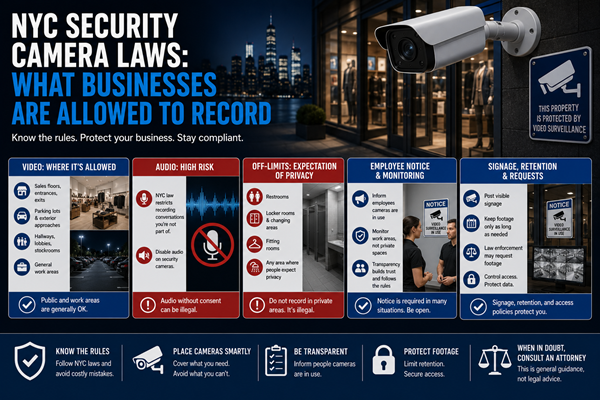

A security camera system is easy to install badly and hard to fix after the fact — and most of the failures trace back to the same handful of avoidable mistakes. The cost of getting them wrong is real: blind spots where incidents happen, footage too poor to use, and gaps you only discover when you finally need the recording. The encouraging part is that nearly all of these are mistakes of planning rather than budget, which means they’re avoidable before a single camera goes up — not problems you’re stuck living with afterward. Here are the eight that come up most often, and how to avoid them, from a New York integrator who’s been called in to fix plenty of them.
1. Poor Camera Placement and Blind Spots
The most common mistake is mounting cameras without a sightline plan. Cameras placed for convenience rather than coverage leave gaps exactly where they’re least affordable — corners, stairwells, the area directly beneath a ceiling-mounted unit, and the overlap zones where two cameras should meet but don’t.
The fix: deliberate placement that traces how people actually move through the space and covers the points that matter. A handful of well-placed cameras beats a pile of poorly aimed ones every time — the difference between a system that captures an incident and one that catches only its edges.
2. Wrong Resolution for the Scene
Resolution mistakes cut both ways. Use a camera that’s too low-resolution for a wide entrance or a parking lot and you’ll capture that something happened without ever making out a face or a plate; slap maximum resolution on every camera, including ones watching a small back hallway, and you’ll pay for it twice — once on the camera and again in storage.
The fix: match resolution to each scene — higher detail where you need to identify people at distance, sensible resolution where general coverage is enough. Put the pixels where they earn their keep.
3. Ignoring Lighting and Night Conditions
A camera is only as good as what it can see, and lighting trips up many installs. A camera aimed into a bright doorway or window silhouettes everyone who passes; one covering a dark lot without proper low-light capability produces footage that’s effectively useless after sundown — which is often when incidents happen.
The fix: account for lighting, glare, and night conditions, and choose cameras built for them. That’s what keeps footage usable around the clock.
4. Undersized Storage and Short Retention
Plenty of businesses install good cameras and then can’t produce the footage they need, because the recorder was undersized. When storage fills, the system records over the oldest footage — so if you only retain a few days, the incident you discover two weeks later is already gone. Higher-resolution cameras eat storage faster, compounding the problem.
The fix: size storage to your camera count, resolution, and how far back you realistically need to look, so the recording is still there when you go looking for it.
5. Weak Network Security (Default Passwords)
Modern IP cameras are networked devices, and treating them carelessly turns your security system into a security hole. The classic mistake is leaving default passwords in place and firmware un-updated — which can let a camera be accessed by people who have no business seeing it, or used as a way into your wider network.
The fixes are basic but essential:
- Change default credentials.
- Keep firmware current.
- Put cameras on their own segmented network.
A camera meant to protect you shouldn’t become the weakest link.
6. No Maintenance or Testing Routine
Cameras are easy to install and forget — until the day you need footage and discover a camera has been offline for months, a lens is caked with grime, or the recorder quietly stopped saving. Systems drift out of working order without anyone noticing, because nobody’s checking.
The fix: a simple routine of periodically confirming cameras are recording, checking image quality, and verifying storage — that keeps the system actually working rather than just appearing to.
7. No Plan for Who Reviews the Footage
Here’s a quieter mistake: installing cameras but never deciding who watches or reviews them. Footage that no one looks at until after a loss is purely reactive — you’ve documented the problem without ever giving yourself a chance to catch it.
The fix: decide up front whether anyone monitors live, how often recordings get reviewed, and whether alerts or monitoring should flag issues. Cameras record; people, or a monitoring service, are what make that recording count in time to matter.
8. DIY Without a Site Survey
The mistake that often causes all the others is skipping the professional site survey and treating cameras as a plug-and-play purchase. Without someone walking the property to map sightlines, assess lighting, plan placement, size storage, and secure the network, a do-it-yourself install tends to accumulate exactly the gaps above.
The fix: a proper survey turns guesswork into a plan, which is why it usually delivers better coverage with fewer cameras — and far fewer surprises down the line.
How 4Wires Avoids These
Every mistake on this list comes down to planning, which is where a professional install earns its value. 4Wires Communications designs and installs camera systems across the New York metro starting with a site survey — mapping coverage, accounting for lighting, sizing storage, securing the network, and setting you up to keep the system working. We design these problems out before they happen, so you get coverage you can rely on instead of blind spots you discover too late.
Want a camera system done right the first time? Learn more about our security camera installation services, or reach out for a free on-site assessment.