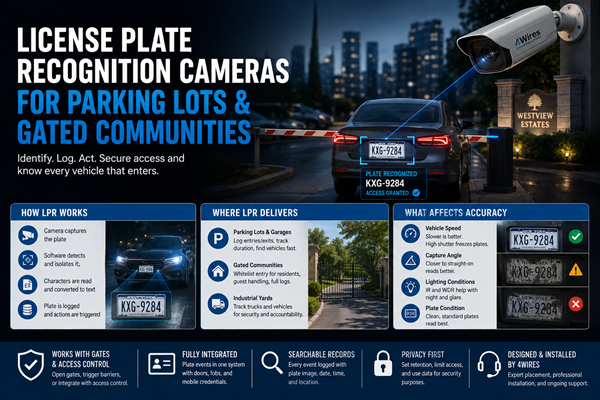

“Put up cameras and crime goes away” is one of the most common assumptions in security — and one of the most oversimplified. Cameras can deter crime, but the picture is more nuanced than a salesperson’s pitch suggests: where they help, how much, and under what conditions all vary. Understanding what actually drives deterrence helps you design a system that prevents incidents rather than just recording them. Here’s a grounded look at the evidence and what it means for your property, from a New York integrator who designs for prevention, not just footage.
What the Research Says About CCTV and Crime
The honest summary is that cameras help, modestly and unevenly. Reviews of CCTV studies have generally found that surveillance is associated with a reduction in crime overall, but the effect isn’t uniform — it’s strongest and most consistent in specific, well-defined settings and weaker in others.
The clearest takeaway from the research is that cameras are not a magic switch that eliminates crime; they’re one effective layer whose impact depends heavily on what kind of crime you’re trying to prevent and how the system is set up. Treating them as a guaranteed cure overstates the case; dismissing them as useless understates it.
Why Visible Cameras Deter (Perceived Risk)
Deterrence comes down to a simple calculation in the mind of a would-be offender: the risk of getting caught versus the reward. A visible camera raises the perceived risk. Someone weighing whether to break into a car or grab merchandise is more likely to walk away if they believe they’re being recorded and could be identified.
The key word is perceived — much of the deterrent value comes from the offender knowing the cameras are there, which is exactly why hiding every camera works against you. Cameras you can see do the preventive work; cameras no one notices only document what already happened.
Where Cameras Work Best — and Where They Don’t
The evidence points to a consistent pattern:
- Works best: planned, opportunistic property crime in contained, defined spaces — parking lots and garages are a frequently cited example, where the setting is bounded and offenders make a calculated choice.
- Works least: impulsive or emotional acts, where the offender isn’t weighing risk at all, and crime in sprawling, hard-to-monitor areas.
The practical lesson is to set expectations accordingly: cameras are a strong deterrent for the theft, break-ins, and vandalism most businesses worry about, and a weaker one for crimes of the moment.
Does Crime Just Move Somewhere Else?
A fair question follows any deterrence claim: if cameras push crime away from one spot, does it simply pop up next door? This is called displacement, and it’s a real consideration — but the research is more encouraging than you might expect.
Studies have generally found that crime prevented in a monitored area isn’t fully displaced elsewhere; much of it appears to be genuinely deterred rather than relocated. In some cases there’s even the opposite effect, sometimes called a diffusion of benefits, where areas near the cameras see a little improvement too — likely because offenders aren’t certain exactly where the coverage ends.
None of this means displacement never happens, but it does suggest cameras tend to reduce crime rather than just shuffle it down the block — a meaningful point when you’re weighing whether they’re worth it.
Deterrence Multipliers (Signage, Lighting, Monitoring)
Cameras rarely work hardest alone. A few additions multiply their deterrent effect:
- Signage: announcing that surveillance is in use boosts the perceived-risk effect, putting offenders on notice before they ever spot a lens.
- Good lighting: a well-lit area is both easier to record and less inviting to begin with, while a dark corner undermines both.
- Active monitoring: someone who can actually respond to what the cameras catch turns a passive record into a live deterrent.
Layered together, these turn a camera system from a silent witness into a visible, credible reason not to try.
Beyond Deterrence: Evidence and Recovery Value
Even when a camera doesn’t prevent an incident, it earns its keep in the aftermath. Footage is evidence — for police, for insurance claims, for resolving disputes, and for identifying who was responsible.
Clear video can be the difference between an unsolved loss and a recovered one, and between a contested claim and a settled one. So while deterrence is the goal, the evidentiary value is the safety net: a system designed well does double duty, discouraging crime up front and documenting it clearly when discouragement isn’t enough.
Designing a Deterrent-First Camera Setup
If prevention is the priority, design for visibility as much as coverage:
- Place cameras prominently: at entrances, parking, and other decision points where an offender sizes up the risk.
- Pair with signage and lighting: the multipliers that raise perceived risk.
- Consider monitoring: for the areas that matter most.
- Still capture identifiable footage: deterrence and evidence aren’t a trade-off when the system is planned properly.
The goal is a setup that announces itself loudly enough to prevent, while quietly recording well enough to prove.
How 4Wires Maximizes Deterrence
Preventing an incident is worth more than recording one, and that takes deliberate design. 4Wires Communications plans camera systems across the New York metro with deterrence in mind — visible cameras placed where they influence the risk calculation, paired with signage, lighting guidance, and monitoring options, all while capturing footage clear enough to be useful if something happens anyway. We design for the outcome you actually want: fewer incidents, and solid evidence on the rare occasion there is one.
Want a camera system built to prevent, not just record? Learn more about our security camera installation services, or reach out for a free on-site assessment.