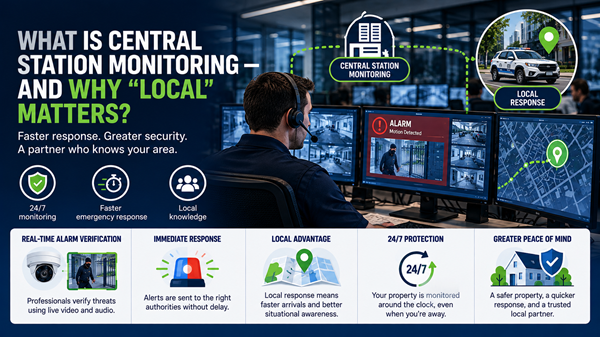

When people shop for a monitored alarm, they ask about sensors, app features, and price. Almost no one asks where their alarm signals will actually be answered. Yet that single detail — the location and local knowledge of the central station — shapes how quickly and accurately your alarm turns into a response.
To be clear up front: no monitoring company controls how fast the NYPD or FDNY arrives — the agencies dispatch on their own protocols. What a station does control is everything before that: how fast it receives and verifies your alarm, and how accurate the information it hands to responders is. That’s where out-of-state and NYC-based monitoring genuinely differ. Here’s how, from an integrator who monitors systems across the city.
How Alarm Dispatch Actually Works
When your alarm trips, the signal travels to whichever central station monitors your account, and an operator there takes over. They confirm the event as best they can, then initiate a request for the appropriate authorities and relay the details — your address, the type of alarm, any access notes, and what they’ve verified.
The responders’ own travel time is out of anyone’s hands. But the station-side portion — receiving the signal, verifying it, and getting accurate information to dispatch — is squarely on the monitoring center, and it’s not the same everywhere. A station that handles that quickly and with local context starts the response sooner and sends responders better-informed.
Why Station Location Affects Response
Distance itself doesn’t slow a signal — alarms travel at internet speed regardless of where the station sits. What location changes is the human handling: how well the operator understands your area, its protocols, and your address.
Local PD / FD Relationships and Protocols
Dispatching in New York isn’t identical to dispatching in any other city. A station that works New York accounts day in and day out knows the local protocols, the right points of contact, and how the process runs here, so the handoff to responders is smooth and correct the first time.
A distant national center handles every region in the country from one floor, following generic procedures across thousands of jurisdictions. It can absolutely do the job, but it lacks the local fluency that lets an operator move quickly and confidently through a New York dispatch without fumbling unfamiliar steps.
Familiarity With NYC Addresses and Building Access
New York addresses carry quirks an out-of-town operator may not parse instantly — the same street name repeating across the 5 boroughs, building-and-unit specifics, access notes for a walk-up or a co-op. An operator who knows the city reads that information correctly and relays it cleanly.
That accuracy matters when responders are trying to reach the right door fast. A clear, correct address and access note from an operator who understands New York buildings beats a hesitant reading off an unfamiliar screen — especially in dense neighborhoods where the wrong entrance or borough costs real minutes on the responders’ end.
Out-of-State / National Monitoring: The Trade-offs
National monitoring centers exist for a reason: they’re large, often well-equipped, and handle enormous volumes efficiently. For a simple account, signals get received and dispatched competently, and the scale can mean robust infrastructure and redundancy.
The trade-off is local context. Handling accounts from coast to coast means no operator specializes in your city, and your address is one of millions nationwide across all 50 states, worked 24/7 from a single hub rather than a familiar local one. The hardware and process can be solid; what’s thin is the local fluency that makes New York dispatch fast and frictionless.
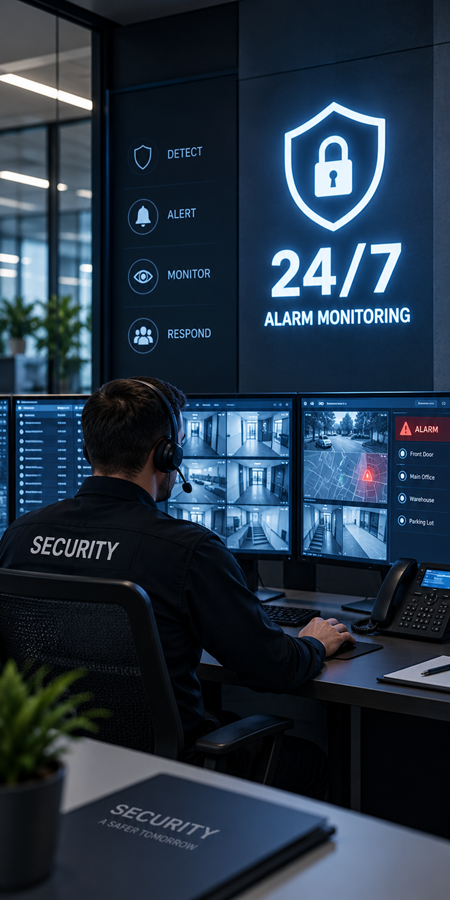
NYC-Based Monitoring: The Advantages
A New York-based or New York-savvy station turns that gap into an advantage:
- Local protocol fluency: operators who run New York dispatches routinely, so the handoff to responders is quick and correct.
- Address and access accuracy: familiarity with borough addressing and building access means responders get clean, correct information.
- Faster, confident verification: local knowledge helps an operator interpret a situation and act without second-guessing unfamiliar details.
- A partner who knows your area: the monitoring is tied to the place your property actually is, not a distant queue.
None of this overrides how fast responders travel — but it gets the response started sooner and aimed correctly, which is the part monitoring can actually influence.
Out-of-State vs. NYC-Based: At a Glance
| Factor | Out-of-State / National | NYC-Based / Local |
|---|---|---|
| Signal speed | Fast (internet) | Fast (internet) |
| Local protocol knowledge | Generic, multi-region | NYC-specific |
| Address & access familiarity | Unfamiliar | Knows boroughs & buildings |
| Verification handling | Standardized, high-volume | Locally informed |
| Your account in the queue | One of millions nationwide | Local focus |
| Responder travel time | Set by NYPD / FDNY | Set by NYPD / FDNY |
Questions to Ask a Provider About Their Station
Before signing a monitoring agreement, ask where and how your alarms are actually handled:
- Where is the central station located? And is it UL-listed?
- Do operators handle New York accounts regularly? Familiarity with local protocols and addressing matters.
- How do you verify alarms before dispatch? And do you support video or other verification on my account?
- What backups are in place? Redundant power and communication paths keep the station running through outages.
- How and how fast will you contact me? Clear notification procedures so you’re never left guessing.
A provider confident in its monitoring answers these readily. Vagueness about where your signals go is a flag worth noticing.
How 4Wires Keeps Monitoring Local
Where your alarm is watched is part of how well it protects you. 4Wires Communications installs and monitors security systems across the New York metro, connecting your alarm to a UL-listed central station with the local knowledge to verify fast and relay accurate information to responders — not a distant center where your address is one of millions. We make sure the part of the response that monitoring can control is handled here, by people who know the city.
Want monitoring rooted in New York? Learn more about our alarm and security system services, or reach out for a free on-site assessment.