
The wired-versus-wireless question usually gets answered badly — someone assumes wireless must be better because it’s newer, or that wired must be better because it’s old-school. Neither shortcut holds up. Both are mature, capable ways to build an intrusion alarm, and the right one depends far more on your building than on which technology sounds more modern.
What actually separates them is how they’re installed, how they hold up, and what they ask of you over the years. Here’s the honest comparison — and why, in many New York buildings, the best answer is a bit of both — from an integrator who installs these systems across the city.
How Wired (Hardwired) Alarms Work
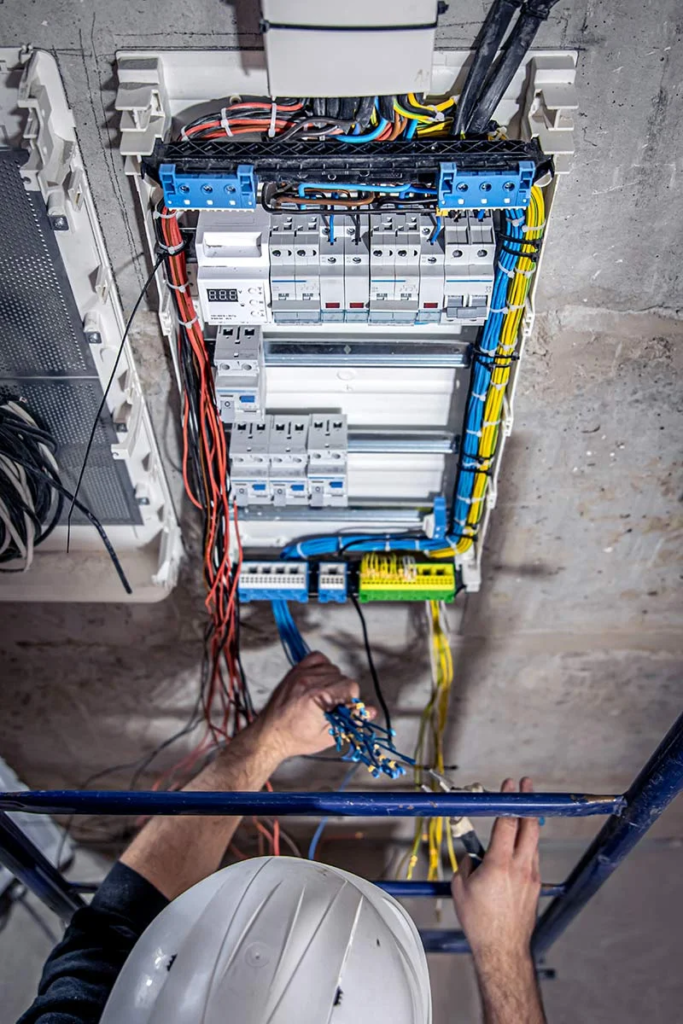
A hardwired alarm connects every device — door and window contacts, motion sensors, keypads, sirens — back to a central control panel with physical cabling. Each sensor has a dedicated wire run, and the panel constantly watches those circuits for the break or change that signals an intrusion.
Because the connection is a physical wire, there’s no radio signal to jam or interfere with, and no sensor battery to replace. The control panel itself has a backup battery so the system rides through a power outage. The trade-off lives in the installation: running cable to every sensor is labor-intensive, which is easy in an open framed wall and a real project in a finished one.
How Wireless Alarms Work
A wireless alarm replaces those cable runs with radio. Each sensor is battery-powered and communicates with the panel over a dedicated wireless signal, so there’s no wiring to pull to individual devices. Modern systems are supervised — sensors check in with the panel on a schedule, so a dead battery or a missing sensor is flagged rather than silently failing.
That makes installation fast and clean, especially where opening walls isn’t an option. The trade-offs are maintenance and environment: sensor batteries need periodic replacement (commonly every 3 to 5 years), and the radio link, while reliable in a well-designed system, exists in a building full of other signals. Good design and quality equipment keep that link dependable.
Head-to-Head Comparison
At a glance, here’s how the two approaches stack up on the factors that actually drive the decision:
| Factor | Wired (Hardwired) | Wireless |
|---|---|---|
| Reliability | Very high — physical connection | High — depends on signal & batteries |
| Interference | None | Possible (RF), managed by design |
| Installation | Invasive — cable to each sensor | Minimal — no sensor cabling |
| Retrofit disruption | High in finished buildings | Low — ideal for retrofits |
| Maintenance | Minimal — no sensor batteries | Periodic battery replacement |
| Best for | New construction, permanent installs | Retrofits, leased space, fast installs |
Reliability and Interference
A wired system has the edge in raw dependability: a physical circuit can’t be jammed and doesn’t rely on a battery in each sensor, which is why it’s long been the choice for installations where nothing can be left to chance.
Wireless has closed much of that gap. Supervised sensors and quality radios make a modern wireless alarm dependable in the vast majority of buildings, with the panel actively flagging any sensor that stops reporting. The honest difference is at the extreme end of reliability rather than in everyday performance.
Edge: Wired for absolute, interference-proof reliability — but a well-designed wireless system is close enough for most buildings.

Installation and Retrofit Disruption
This is where wireless wins decisively. In an occupied office or a finished prewar building — plaster walls, no easy conduit, tenants in place — pulling cable to every door and window is invasive, time-consuming, and disruptive.
A wireless system sidesteps all of it: sensors mount where they’re needed without fishing wire through walls, so a retrofit goes in faster and cleaner with far less mess. For a brownstone, a leased suite, or any space you can’t tear open, that difference is decisive.
Edge: Wireless, clearly, for retrofits and finished or occupied buildings.
Maintenance
A wired system asks little of you once it’s in — there are no sensor batteries to track, so upkeep is minimal for years.
A wireless system trades that for periodic battery replacement across its sensors, commonly every 3 to 5 years per device. It’s a manageable task, and supervised systems warn you before a battery dies, but it is an ongoing responsibility that a wired system simply doesn’t have.
Edge: Wired — nothing to replace once it’s installed.
Cost
Cost is the factor most often misread, because the hardware isn’t the whole story. Wired sensors are inexpensive, but the labor to run cable to each one is significant — which makes wired most cost-effective when the walls are already open, as in new construction.
Wireless sensors cost a bit more per device, but installation is quick and low-labor, which often makes wireless the more economical choice in a finished building where wired labor would be steep. The cheaper system depends entirely on what’s behind your walls.
Edge: Depends on the building — wired for new construction, wireless for most retrofits.
New Construction vs. Existing Building
The construction stage often makes the decision for you. If you’re building out a new space or doing a major renovation with walls open, wired sensors are easy to install and give you the most permanent, maintenance-free system — it’s the natural moment to hardwire.
In an existing, finished building — the common case across New York — wireless usually wins on disruption and labor, getting a full alarm in place without tearing into walls or interrupting the business. Matching the technology to the construction reality is more sensible than insisting on one approach everywhere.
Hybrid Systems: Best of Both
You don’t actually have to choose one technology for the whole building. Most modern control panels support both, which lets a professional design draw on each where it fits:
- Wired where it’s easy: hardwire the doors and sensors near accessible runs or in newly opened walls, for permanent, battery-free reliability.
- Wireless where it’s hard: cover finished areas, additions, and out-of-the-way openings with wireless sensors, avoiding invasive cabling.
- One panel, one system: both sensor types report to the same control panel, so the building has a single, unified alarm regardless of how each device connects.
This hybrid approach is often the practical best answer in a real building — the dependability of wired where you can run it, the flexibility of wireless where you can’t.

How 4Wires Designs Your Alarm
The right alarm isn’t wired or wireless on principle — it’s whatever fits your building, your construction stage, and how you’ll live with it. 4Wires Communications designs and installs intrusion alarm systems across the New York metro, working with trusted brands like Honeywell, DSC, and Napco. We assess your space — new or finished, owned or leased — and design the system around it, hardwiring where it’s practical and going wireless where it isn’t, often blending both into one clean, dependable alarm.
Deciding how to protect your property? Learn more about our alarm and security system services, or reach out for a free on-site assessment.